
Community Share
“Community Share” is a way of retracing websites, creative works, and topics shared during our Poetry Cave gatherings. I periodically update this page as new shares occur.
The apotheosis of form is when it’s shared.
JUNE 2026
[link here to this month’s poetry]
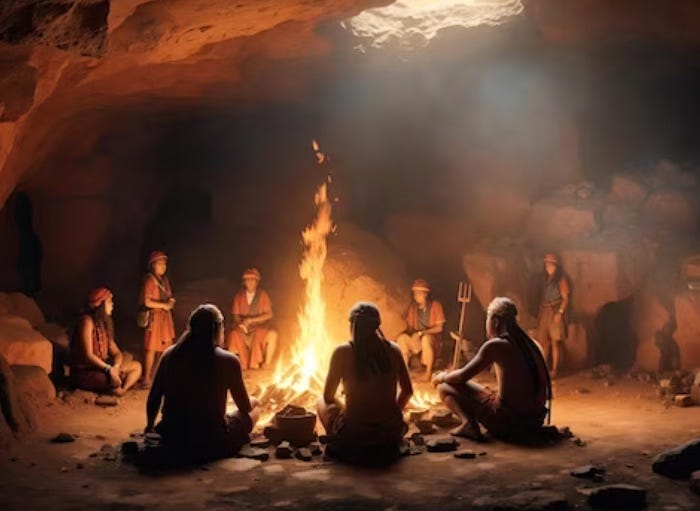
Imagine our fathers gathered together in a single room - or cave - talking about us, their sons. Remembering us…
*
MY FIRST BASEBALL MITT -Carl C.
My father tossed the baseball to me
It hit my glove and fell
Again, he tossed the ball and again I did not catch it.
Again.
Again.
….and again and again…
I was afraid of the hard ball
And I let it hit my glove and fall to the ground.
Was that disappointment in his eyes I saw?
I never asked.
He is gone and I still am wary
to play catch with a baseball.
*
SONS AND FATHERS -Kurt M.
Two images of a father—
one stern, one tender.
our rearview yearnings
Both. Yes, both are true.
The boy receives something
the same as forward ones
then kisses his father.
It’s called an inheritance,
all fabricated except for
sacks of precious metal
to be carried over mountains
the rough stones underfoot
and through a wilderness.
It’s also called a blessing,
that make the walk difficult
which is essentially a curse
slyly angled into the heart.
but we carry on
Either way, the boy kisses his father.
into unfamiliar lands
*
MERCURY DESCENDING -Kurt M.
I twisted your beloved Mercury
around a telephone pole—splintered—
a black angel circling above
with you sitting right beside me.
My sisters—your daughters—
spinning us on his sharp scythe
nearly killed in a hurricane of glass.
In my white-hot shame you prophesied
a column of steam rising from hell
that God had laid his chastening
hand on my too-proud shoulder.
a white angel kneeling in the grass
As I spiraled into a whirlpool of anguish,
you put your arm around that same shoulder
tells us that she will not die
and told me everything would be okay.
but don’t move her even an inch
*
STORY –S.P.
Never! – “Noon” – I set out –
A bird – a field of dry corn – one road
climbing the Earth – one planetary road.
Sky – he slit the sky –
Necessities rained down like an array of garden tools –
There was no sound to their sudden clamor.
The father
turned,
and tuned his faith
to a newer stone.
MAY 2026
[link to this month’s poetry ]
This month our poiesis word experiments arose from bringing attention to Nature’s aliveness as a spontaneous presence inside us.
We checked in with ourselves using a repetitive writing prompt. Repetition restricts the imagination and at the same time, paradoxically, structures a kind of frame or new opening through which imagination’s unpredictable liveliness may emerge. This was written using the recurring prompt: “My aliveness…”
My aliveness is a scratchy left eye and tinnitus. My aliveness is fatigue and slightly queasy and “carbuncle.” Why carbuncle? It just popped up. My aliveness breathes, after forgetting to breathe. My aliveness is a long string of melancholy reaching back through a hallway of many lifetimes. My aliveness is histories beyond reckoning, people I know and love now who I knew and loved then, in different forms. My aliveness sees an eagle land. I remember not thinking you could see eagles anymore, and when I saw one in the Croton Gorge I didn’t know what it was. My aliveness imagines I am that eagle. My aliveness is afraid of suffering and loss. The eagle seems transfixed by the sun – perched on a tall dead tree. My aliveness is about wondrous dot of Light encased by all I see and hear and feel at each moment. Inside this vehicle of feelings and sights and sounds – and inside you who are writing this down and have doubts, – My aliveness knows exactly what I’m doing…
Is human imagination part of Nature? Is Imagination some kind of Spirit World in itself? Let’s say: Human beings appear to possess – or are possessed by – a mysterious interior life-form “who” uses images and sounds through which to flower and roam the world…
Near the end of this Poetry Cave gathering, we drew an open square on a page, chose a line from Nerval’s “Golden Lines” as inspiration, and followed the flow of imagination until each person’s square was filled with words. In this poiesis experiment, that open square served as our frame, and the words filling it up were like a large creature crowding the window: Imagination’s Creature, let’s say. Many of us experienced Imagination’s proclivity for bringing us closer to our hearts. Almost like a trick of tenderness.
The Aftermath. -Rich M.
The layers of stone hold water
long after the storm has passed
And the table listens in darkness
to the slow settling of the house.
The dust drifts through the sunlight
only to hesitate before landing,
as if it, too, is remembering the past
And the stars, the stars,
why would they burn quietly
unless their silence could feel?
You, my love, are their sister. Do you remember
the day we huddled under the oak table
during the ice storm, as still as stones,
waiting for the stars to come out and
show us the aftermath?
*
Her Joy -Steve P.
“In that blind wall, look out for the eyes that pierce you…
Every flower is a soul opening out to nature.”
I expand, dilate, thin out, and you can’t see me any more.
I am hiding in the rhododendron bushes! It’s so cozy in here.
When my new friend comes by, I say, “I’m here.”
She ducks down in and sits next to me on the ground beneath the flowers.
I can feel her sudden joy.
I didn’t know she would die in 17 years and be my son’s mother.
“And everything moves you…” – Gerard de Nerval
Whether we think of Imagination as “the eye of the Heart” or “an extra-terrestrial life-form” or as a visionary gateway into the spirit world – or as Nature itself “with a human touch” – whatever Imagination may be, infinite magical fecundity appears to be its signature:
Rich M. shared that his new novel, The Connection in Everything, will be released on September 1st.
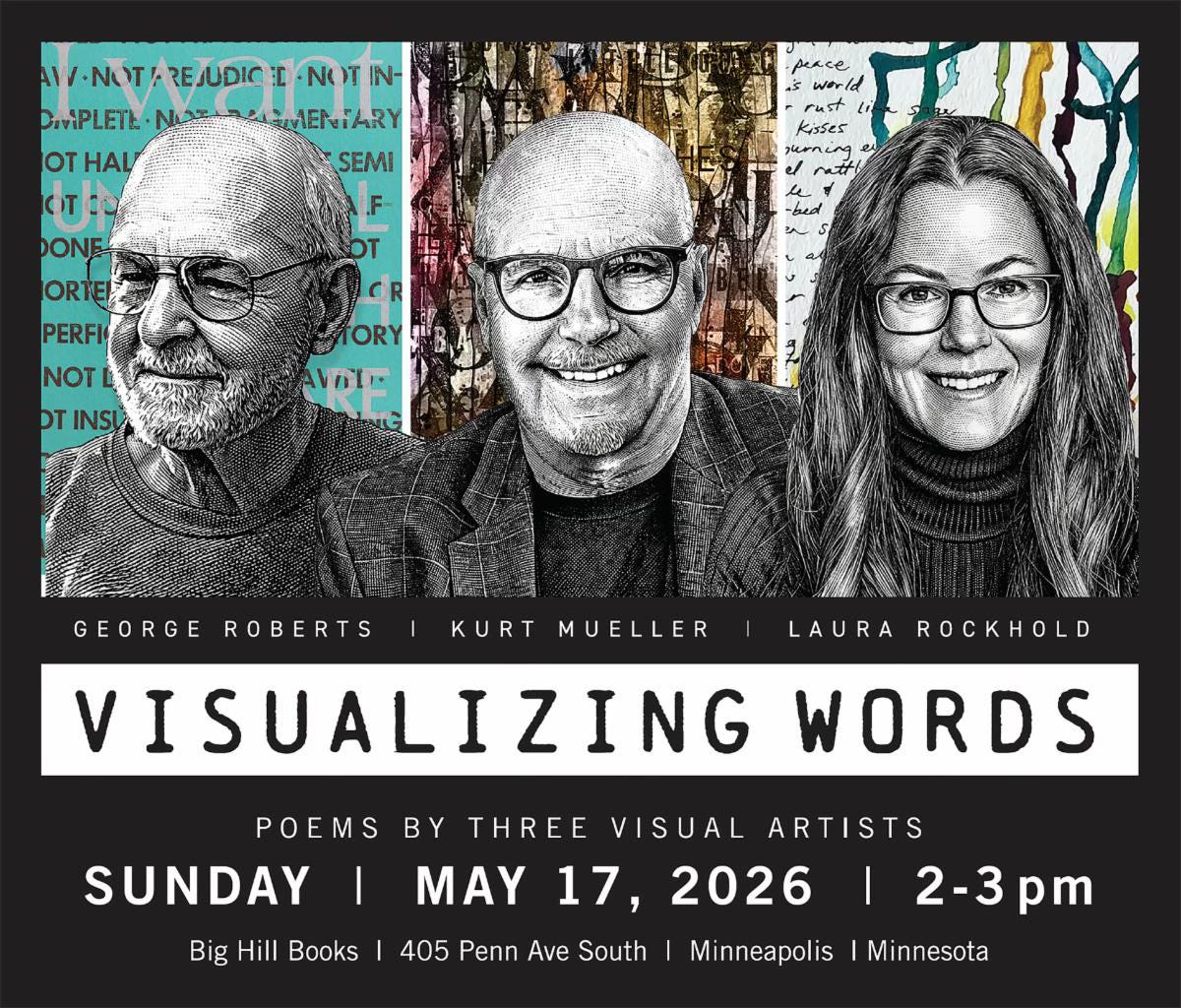
Kurt M. shared that he’s participating in a poetry reading in Minneapolis, May 17.
APRIL 2026
This month, our POIESIS EXPERIMENT (“knowing-by-making”) used the idea of writing an ACROSTIC with the option of adding an additional line if you wish.
To write the acrostic, each person chose a word they wanted to explore, wrote the word vertically, and then used the letters of that word to discover additional words somehow resonating with the original word. Example:
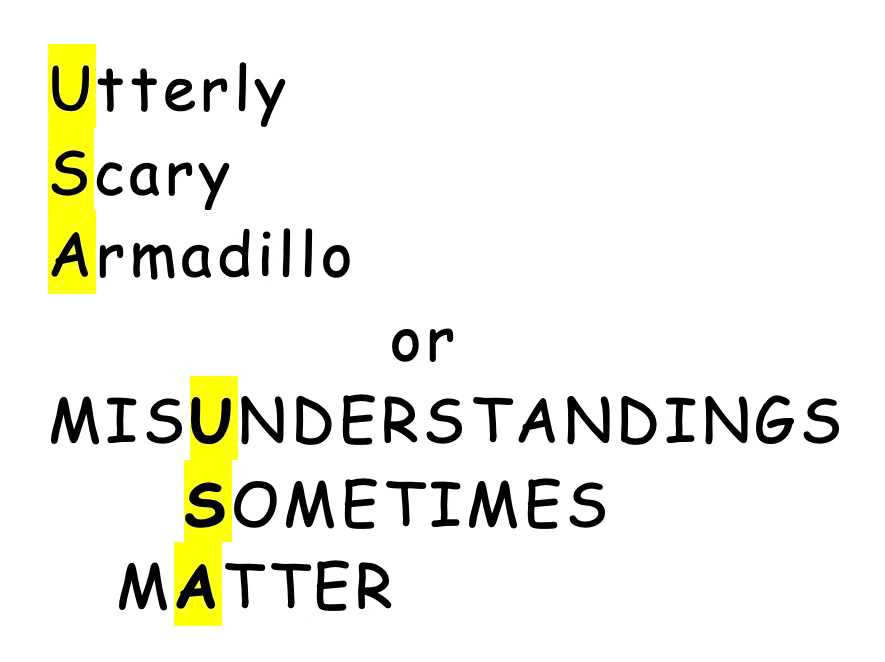
The word written vertically acts as a creative restriction or frame for imagination to push against and “spring” from. What follows are a few examples of what bloomed. They are typed horizontally, using the original vertical word as title. (Some of the word experiments include an optional additional line, in italics.)
Enjoy the subtle associations and connections even if the sequence of the words seems illogical or disconnected on the surface. It’s almost like reality itself - what’s “really” going on is under the surface, behind the scenes, almost invisible… And can only be felt.
FASCINATION
Flying Astronaut Shawnee
Canoe Indian Nature
Africa Tomahawk
Iola Ocean Namath
When I imagine, I am a boy again J.C.
PEACE
Perfect excellence after cloudy delirium
Even a child can do it! S.P.
ANTLERS
hark! answer.
gift flower be spring!
Simple A.M.
…Meanwhile, inspired to blend together the essences of the two poems we had just been talking about, one of us used his poetic license to follow an entirely different imaginal track…
Imagine the ordinary as mythic
The mornings as Godly
The afternoons as
golden gears,Mandelbrot screens,
glistening sweat
The evenings as
gentle touch
ancient talk
Stitch the hours into belonging
Until your stories join and remember themselves as love
Once, long ago, they did -Rich M.

Michael W. shared these words of Lewis Hyde from The Gift:
“The passage into mystery always refreshes. If, when we work, we can look once a day upon the face of mystery, then our labor satisfies. We are lightened when our gifts rise from pools we cannot fathom. Then we know they are not a solitary egotism and they are inexhaustible.”
And John C. shared this interesting link about what Colorado’s Poet Laureate has to say about why poetry matters.
MARCH 2026
ROBERT BLY’S IMAGES AS “HEADLINES”
from The Light Around the Body (1968)
...Underneath all the cement of the Pentagon
There is a drop of Indian blood preserved in snow…
…we are teaching the children of ritual
To overcome their longing for life…
…we send
Sparks of black light that fit the holes in the general’s eyes.
There are longings to kill that cannot be seen,
Or are seen only by a minister who no longer believes in God
The cry of those being eaten by America,
Others pale and soft being stored for later eating…
The light in children’s faces fading at six or seven.
Tonight they burn the rice supplies; tomorrow
They lecture on Thoreau; tonight they move around the trees,
Tomorrow they pick twigs from their clothes;
Tonight they throw the fire-bombs, tomorrow
They read the Declaration of Independence; tomorrow they are in church.
...We make war
Like a man anointing himself
We are the ones we intended to bomb
–Robert Bly
Haiku experiments exploring “SACRED POWER”
Shy daisies wake up.
Nothing we can do about it—
close or open eyes.
K.M.
Weighty choice to make—
Troubled by the consequences,
rustle in the pines…
J.C.
The chainsaw growling…
A hawk tends to its young
A man notices the hawk.
J.M.
I try to find them
Those I wish I stood up to
But who are they now?
J.M.
The futility
of fanning smoke away from
my fire of longing!
S.P.
Sun and earth-bound bud,
round and round in playful dance;
life’s romance for all!
D.D.
Dim room, they gather…
The symphony moves as one,
We leave, together
M.F.
Robert Bly – “Acceptance of the National Book Award for Poetry” (1969)
I am uneasy at a ceremony emphasizing our current high state of culture. Cultural prizes, traditionally, put writers to sleep, and even the public. But we don’t want to be asleep any more. Something has happened to me lately: every time I have glanced at a bookcase in the last few weeks, the books on killing of the Indians leap out into my hand. Reading a speech of Andrew Jackson’s on the Indian question the other day – his Second Annual Message – I realized that he was the General Westmoreland of 1830. His speech was like an Administration speech today. It was another speech recommending murder of a race as a prudent policy, requiring stamina. Perhaps this coincidence should not have surprised me, but it did. It turns out we can put down a revolution as well as the Russians in Budapest; we can destroy a town as well as the Germans did Lidice – all with our famous unconcern.
As Americans, we have always wanted the life of feeling without the life of suffering. We long for pure light, constant victory. We have always wanted to avoid suffering, and therefore we are unable to live in the present. But our hopes for a life of pure light are breaking up. So many of the books nominated this year – Mr. Kozol’s on education in the slums, Mr. Styron’s, Mr. Mumford’s, Mr. Rexroth’s, Miss Levertov’s, Mr. Merwin’s – tell us that from now on we will have to live with grief and defeat.
We have some things to be proud of. No one needs to be ashamed of the acts of civil disobedience committed in the tradition of Thoreau. What Dr. Coffin did was magnificent; the fact that Yale University did not do it is what is sad. What Mr. Berrigan did was noble; the fact that the Catholic church did not do it is what is sad. What Mitchell Goodman did here last year was needed and in good taste. The sad thing is that the National Book Committee, in trying to honor those who told the truth last year, should have invited as a speaker Vice-President Humphrey, famous for his lies. Isn’t the next step, now that individual people have committed acts of disobedience, for the institutions to take similar acts? What have our universities done to end the war? Nothing. They actually help the war by their defense research. What has the book industry done to end the war? Nothing. What has my own publisher, Harper and Row, done to help end the war? Nothing. In an age of gross and savage crimes by legal governments, the institutions will have to learn responsibility, learn to take their part in preserving the nation, and take their risk by committing acts of disobedience. The book companies can find ways to act like Thoreau, whom they publish. Where were the publishing houses when Dr. Spock and Mr. Goodman and Mr. Raskin – all three writers – were indicted? What the publishing houses do is up to them. It’s clear they can have an editorial policy: they can refuse to pay taxes.
These concerns are not unconnected to such a ceremony as this. For if the country is dishonored, where will it draw its honor from to give to its writers? I respect the National Book Awards, and I respect the judges, and I thank them for their generosity. At the same time, I know I am speaking for many, many American poets when I ask this question: since we are murdering a culture in Vietnam at least as fine as our own, have we the right to congratulate ourselves on our cultural magnificence? Isn’t that out of place?
You have given me an award for a book that has many poems in it against the war. I thank you for the award. As for the thousand-dollar check, I am turning it over to the draft-resistance movement, specifically to the organization called the Resistance. [Whereupon Mr. Bly handed the check to Mr. Mike Kempton, who was representing the Resistance.] I hereby counsel you as a young man not to enter the United States Army, now under any circumstances, and I ask you to use this money I am giving you to find and to counsel other young men, urging them to defy the draft authorities – and not to destroy their spiritual lives by participating in this war.
March 6, 1969
FEBRUARY 2026
After Poetry Cave, Kurt M. wrote:
“…A moment from today’s Cave that stands out for me was [one man’s] tale of having his wife find out, after the fact, that he had praised her to a friend. It was sweet. Perfect for Valentine’s Day. I thought Steve chose Bedrock specifically to fit Valentine’s Day. Later reflection made me think that the experience of nature was a “bedrock” for Gary and Masa’s relationship…something that grounded them.
The final writing exercise brought up a specific moment that led to a little Valentine’s poem for my wife. It sort of echoes the timeless quality of a single moment that I felt in Snyder’s poem.
QUASAR
From a distance, I see you
we spend too much time
through my viewfinder,
trying to imagine eternity
posing at the base of a colossal
and the brilliant quasar
Douglas fir, seeming smallish,
is burning bright before us
but filled with enough light and grace
like there’s no tomorrow
to enchant the entire woods.
and yesterday never was
Jeb wrote:
A lone tree next to a thawing pond
A fire with a hearth is nearby
A granite face looks on…
Was thinking of my father
“It’s funny because I didn’t think of the idea of the granite face ‘looking on’ until I was actually speaking aloud my four images to the group… With that particular experiment we had a limited amount of time which really forced us to write down the first thing that arose. No time for overthinking. And then it’s interesting to come back later and look at what we have and see how much meaning it offers. Sometimes way more than we originally anticipated. Especially if in the act of writing down the images we’re thinking ‘this is gobbledygook!’ Haha.”
NOVEMBER 2025
WHAT IT TAKES TO LOOK INTO SOMEONE ELSE’S EYES: Rich M shared Pema Chödrön, “The only reason we don’t open our hearts and minds to other people is that they trigger confusion in us that we don’t feel brave enough or sane enough to deal with. To the degree that we look clearly and compassionately at ourselves, we feel confident and fearless about looking into someone else’s eyes.”
STAYING IN TOUCH WITH THAT DEEP SELF: Steve P shared William Stafford, “In your life – the center of it, not the part for earning a living, or the part that gains you notice and credit, or even the part that leads others to like you – but in the central self are feelings so important and personal that the rest of the world cannot glimpse who you are and what is happening, deep there, where it is you alone
“Some people find ways to stay in touch with that deep self, even when buffeted by worldly demands. One of the ways is through literature, the writing of it and the reading of it.
“But literature is not just the language of the workaday world… Literature comes from an adventure in language, a dipping into that central self and coming up with stories, pictures, memories, dreams….” –from intro to A Scripture of Leaves
SEPTEMBER 2025
Sculptural & Printed Works by Kurt Mueller:
www.kurtmuellerstudio.net (art)
www.tangrambooks.net (fiction, memoirs, poetry)Novels & Poetry by Rich Marcello:
https://richmarcello.com/
JULY 2025
John C shared an excellent essay by A. O. Scott shimmering with hints of the power, magic, and purpose of poetry: “I Want This Poem Read Aloud at My Funeral”
FEBRUARY 2025
Michael W: …I wanted to share a quote that a college classmate recently shared, which surfaced for me today. The themes of memory and mystery are alive in it....
How brief and magical it was that we all lived so close to each other and went in and out of each other’s rooms, and our most important job was to solve mysteries.
It’s from the novel Either/Or by Elif Batuman (character reminiscing about their college days...)
“The Connection in Everything” [lyrics below] This song was shared by Matt F., following our talk about traditions regarding “the red thread.”
THE CONNECTION IN EVERYTHING [Rich Marcello]
There’s a link to you in everything
A red thread that’s unseen
You’re the water, the sky, the mattress springs
You’re in the cracks and crevices in between
I longed to show you the winter night
The North Star, my diamond ring
But you weren’t having any of it, were you, baby?
As you sailed along the upswing
What would you do now
If you passed me on the street?
Would you be a witness to the harm,
To my defeat?
Would your eyes hold a long overdue
A second, a second coming?
Or just the altar where I’d kneel and wash your feet?
There’s a connection to you in everything
A connection in everything
Can a hollowed man return to before?
Can emptiness fill?
Can I learn to unwind this fate?
This infinite until
There’s a connection to you in everything
A connection in everything
I’ve fought too much for the past
Who I imagined we were before
But you can’t go back, can you baby?
We need to live in this world to end this war
There’s a connection in everything
A connection in everything
There’s a connection in everything
A connection in everything
There’s a blessing in everything
DECEMBER 2024
Shared by Steve W. during our gathering to explore poems by Emily Dickinson and César Vallejo.
OCTOBER 2024
DILEXIT NOS (“He Loved Us”) – shared by John C, inspired by discussion around October’s Poetry Cave theme The Inward Man.
Additional commentary: “The world seems to have lost its heart.”
JULY 2024
Playfully created and shared by Kurt Mueller, for our gathering on Zoom to explore the poem, “Stone.” (Which stone are you?)
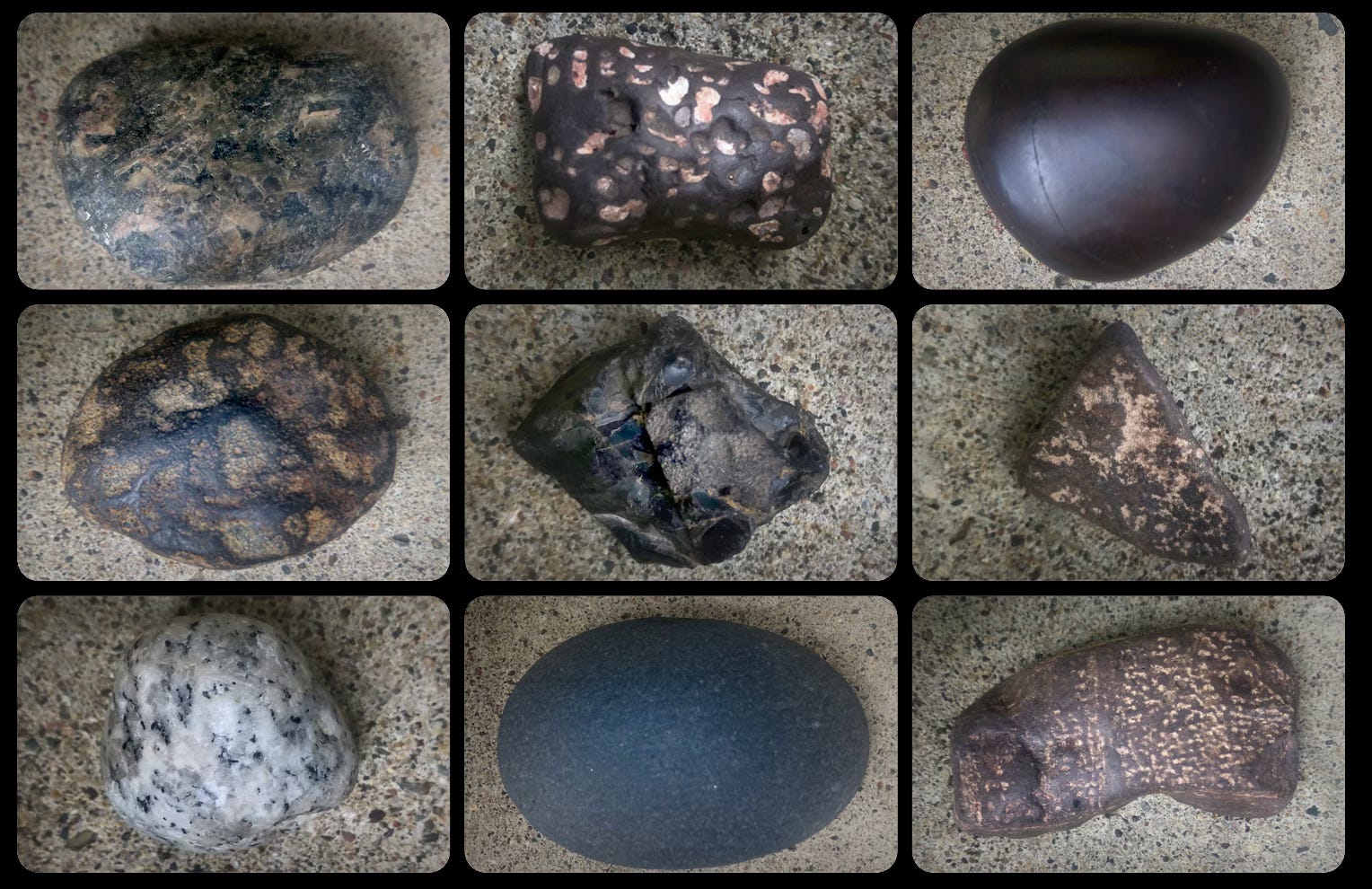
Shared by Jim G, “Moon Behind the Hill” – echoing an image from the poem “Stone,” by Charles Simic:
…I have seen sparks fly out
When two stones are rubbed,
So perhaps it is not dark inside after all;
Perhaps there is a moon shining
From somewhere, as though behind a hill –
Just enough light to make out
The strange writings, the star-charts
On the inner walls.
MOON BEHIND THE HILL –William Keneally
I watched last night the rising moon.
Upon a foreign strand,
Till mem’ries came like flowers in June,
Of home and fatherland ;
I dreamt I was a child once more,
Beside the rippling rill,
When first I saw, in days of yore.
The moon behind the hill.
It brought me back the visions grand
That purpled boyhood’s dreams.
Its youthful loves, its happy land,
As bright as morning beams;
It brought me back my own sweet Nore,
The castle and the mill,
Until my eyes could see no more
The moon behind the hill.It brought me back a mother’s love,
Until, in accents wild,
I prayed her from her home above
To guard her lonely child;
It brought me one across the wave
To live in mem’ry still;
It brought me bank my Kathleen’s grave,
The moon behind the hill.And there, beneath the silv’ry sky
I lived life o’er again;
I counted all its hopes gone by,
I wept at all its pain;
And when I’m gone, oh! may some tongue
The minstrel’s wish fulfil,
And still remember him who sang,
“ The Moon behind the Hill.”