Seance As If
Two Fathers, Two Sons

Facet One
When I arrived at his door that morning, Lee Roberts was already standing there. We did the niceties. He invited me in. We walked down the hall to a large room with a fire going in this big fireplace and lots of light coming in through the French doors with snow shining outside that had just fallen the night before. This didn’t feel like a seance.
Thanks for reading Spirits, Nature, Oracles, Art! Subscribe for free to receive new posts and support my work.
“Would you like some tea?” he asked. I was more in the mood for strong coffee, but he said he didn’t have any, and offered something else instead called yerba mate. “Yerba will perk you up too, but in a different way. It’s subtle. It sort of opens your mind sideways. I love coffee sometimes, but for the work we’re doing today, coffee’s too much of a locomotive to Manifest Destiny….” He checked to see if I got his drift.
“Coffee’s the aggressive American drink.”
“It’s one daily way we plow everything under.”
“Well, it does keep you on task.”
“Yeah,” he said. “But what task are we talking about, and who’s the taskmaster?”
The guy seemed edgy. A chip on his shoulder maybe.
He shared a little about himself, but I already knew quite a bit. The internet had made it clear that this self-described researcher wasn’t any kind of scientist to speak of. He had a degree in counseling from out in Oregon somewhere. Later, he went to Switzerland where he trained in using different kinds of art in odd ways to promote literacy and parenting in, of all places, a women’s maximum security prison in New York. Having done that for nearly two decades, he was now doing this. I figured at some point I would ask him why.
He had written some things too. I was curious about his article in Psychology Today, “Rapport Theory,” but not that curious, and his “experimental memoir about love and imagination” didn’t interest me enough to read it before coming here, though maybe I should have. My jaw was starting to hurt as he stood here talking about communication with the dead as if it was all just a matter of building rapport. His idea of “rapport work” didn’t even sound human.
“The basis of postmortem interplay,” he said, “is that there’s this whole undiscovered world of subtlety within reach of our perception, and it can’t be colonized with the mind. And anyone who tries to exploit it will be biting the hand that feeds them. Yerba allows for a kind of subtle receptivity that coffee might otherwise extinguish. Both have power, but there are different kinds of power.” He paused and pulled at his nose. “Hell, look at me. Lecturing. Fuck!”
It’s funny how the word fuck can get you to relax. I sort of smiled as he handed me a steaming cup of that tea.
“From the leaves of a South American holly tree.”
Its mild fragrance was appealing. And when it cooled down enough to take a sip, I liked its taste too. Something different.
I followed as he gestured toward two chairs from what looked like the 1920’s and we sat down by the fireplace, saying little, each blowing and sipping our tea. There was something about the way the chairs angled toward each other. For some reason, that angle mattered. And the fire in the fireplace was a third thing.
As he wrapped up his introduction, telling me a few final details that I already knew, he nodded at the tiny pinecone I’d taken out of my coat pocket when we first sat down.
“Tell me about it.”
Something held me back.
“Did you want to take your coat off?”
It seemed like a reasonable idea, but I ignored his second question so that I could respond to the first. “An object from nature. Your message said to bring an object from nature….” My voice disappeared.
“Connected with your son.”
“Yes.”
There wasn’t much to say. I told him I had walked around outside with my son in mind, as instructed, saw the pinecone and picked it up. That’s all. The pinecone stayed on my windowsill and I forgot about it till today when I was leaving to come here, and it caught my eye.
Roberts waited, still listening.
“I don’t see much of a connection between my son and a pinecone.”
“Let’s look at this particular pinecone. It’s little.”
I held it between us in my open palm, noticing it had gotten slightly smashed in my pocket. The pinecone seemed like a tiny body.
“I mean, he did like them. I remember him liking pinecones when he was little.”
“What did he like about them?”
I couldn’t remember. I was distracted by the fact that the pinecone had gotten damaged.
The fire popped.
“Tell me about your son.”
“Do you have any kids?” I asked.
“A 21 year-old son,” he said, gaze steady. His eyes moistened, betraying private knowledge. We had now become two fathers sitting across from each other. Okay.
Still, I told him I didn’t want to say too much about my son because he might use the information to fake a psychic reading.
“As seen on TV…,” he said.
I smiled but it felt like a scowl. “I’m not sure I even want to say his name,” I said.
“Okay.”
“I just think the less you know, the better the chances I’ll feel like something’s really happening here.”
“You have your doubts, sure.”
“I am curious, though.”
“In this experiment, what matters isn’t what I say, really, but what you perceive.”
“What I perceive.”
“I’m not a medium, and what we’re about to do here” — his eyebrows lifted to crown a kind of ironic smirk — “is not a Ouija Board.”
I tell Lee Roberts I’d like to know more about this method he said he’s researching. Nodding, he turns toward the fire. I face the fire too. It’s a soothing thing. The flames look twitchy yet almost happy, flowing upward. Despite the sunlight in the windows, it’s bitterly cold outside and there’s a faint chill coming off the glass. Our chairs sit just a few feet away from the fireplace. The glow and warmth feel good.
“I’ve always been fascinated by the imagination,” he says. “I’ve always wondered what it actually is.”
His eyes leave the fire and look toward mine.
“You want me to answer?”
“What are your thoughts about the nature of human imagination?”
“I haven’t thought about it.” My tea on the table next to us catches my eye, so I take a sip. It really is sort of an interesting flavor, yet not that big of a deal at all. “It’s just something in your mind, ” I say, “the mind making things up, I guess. It can be useful for solving problems, for imagining different possibilities. Dreams are part of it.” I take another sip. He’s drinking his tea too. The subject basically confuses me. I don’t particularly like being confused.
“It can be misleading,” I say, “like people mistaking fantasy for reality. Imagination causes misunderstandings, seeing things that aren’t there, misconstruing what people say because we’re imagining something else. Mixing things up. Hallucinations too, if you’re mentally ill — imagination out of control.”
“So many different things fit into that one word,” he says. “I once asked a bunch of 7th graders, What’s the imagination? A girl raised her hand. ‘It’s the best part of the mind,’ she says. That idea has always stayed with me.”
“Best part of the mind….”
“Yeah. Imagine that.”
Several days before coming here, on the phone, I had asked Roberts about the content of his newspaper ad to which I was perhaps recklessly responding — Experimental method of postmortem communication: Volunteers needed! Find out more with 2RS.
“What’s 2RS?”
“2 R’s, Radical Rapport,” — he sounded like a professor — “with Spirits, S.”
“Spirits….” I needed to feel the word in my mouth. Maybe see if I could somehow get it in my head. He offered no further explanation, and I didn’t ask for any. We set up the appointment and that was that.
Now as he adds a log to the fire, I’m telling him, “I don’t really believe in spirits.”
“You don’t have too,” he says, plopping back into his chair. “That’s why I call this sort of rapport radical, as in extreme. Like a terrorist! But no, I mean extreme as in far from what’s conventional for most people in our current phase of civilization.”
“Marginal.”
“Fringy! Flakey!” he smiles. “Maybe I use the word radical to bring some revolutionary dignity to the matter. But also, radical as in root. Going to the very foundations of our being, of experience itself. Rapport with spirits takes us to the limits of the isolated self, of who we think we are. Who we imagine we are.”
“But in this day and age, what does spirit even mean? Like literally a ghost?” I turn away. The fire’s bright. I look out the windows at the snow, it’s even brighter.
“To tell you the truth, I’m not completely sure what a spirit is,” he says. “But the Uncertainty Principle is an accepted part of science now. It’s a good metaphor — and a healthy fact to just admit! Put it this way, in the language of play, we could say I play this 2RS spirit game by starting with one basic rule.”
“And what is that?”
“I define spirit as anything with a definition.”
“I don’t know what you mean.”
“Play along with me here and we’ll think about it together.”
I nodded. He cleared his throat. His eyes seemed to be calculating something far back in a broom closet in his brain or whatever he had going on in there.
“Okay. The definition of a thing forms a perceptual boundary around that thing. This boundary, like the frame around a painting, illuminates the entirety of that thing as a distinct entity unto itself. This unique wholeness of the defined thing, no matter how simple or complex, is its spirit, its aliveness.
“I always thought a spirit was supposed to be inside the thing?”
“The way I’m talking about it, it is the thing, made visible, alive, by the boundary of its definition, its name — by what we call it.”
I had to look back at the fire for a moment. I took a breath. He plowed on….
“Let’s say there’s a flower in a vase in the space between us. If I refer to that flower, and we both know the definition of flower, then you will see that flower and know what I’m talking about without my even having to point to it. I can say, ‘The flower is here,’ and you’ll see it!”
As if looking at that flower, his eyes stared at the little table between us where, in fact, there was no flower.
“But if you don’t know what flower means, if you don’t know its definition, you won’t see what I’m talking about. It would be as if we’re in two separate dimensions! But actually we’d be in two different language games.”
“Language is a game?”
“I call it a game, not pejoratively, but just to point out that there’s an element of play in all our interactions according to agreed upon rules of perception defined by our language. We play along with each other, according to these rules, in order to feel connected. Language shapes the mind, and you and I can’t find common ground if there’s no common language. It’s the same between the living and the dead. 2RS is a language that the living and the dead may share in common — it’s actually a cluster of languages.”
“I’m totally losing you here,” I said.
“Our definition of things outlines them, making them distinct in the otherwise out-of-focus blur of our perception. Through its outline or definition a thing becomes present in our perception.”
“That would mean everything is a spirit.”
“Yes. Within this particular philosophy. A philosophy of spirits is not an absolute reality or some dogma you have to bow down too. It’s just a perspective, a way of seeing. You can try it on like a pair of glasses. It’s a game you can play, participate in, see? In this game anything defined by a name becomes a discrete entity. And the discreteness or completeness of that entity is also the wholeness of its living spirit. It’s like human beings are the Namers in this chaos, and anything we single out with a name or definition immediately stands out from the blur of the background to become a presence in our minds, and in our hearts too!
As he grew more and more excited, I turned away toward the fire, which was simmering down, but kept listening. He was the fire in the room now.
“You are a spirit. I am a spirit. This fire is a spirit. My shoes are two spirits! That tree outside the window — just feel what sort of spirit that is.”
It looked like some kind of pine to me, though it may have been a fir. Probably because of the way he was talking I noticed how the tree had its own way of standing, different from the other trees nearby. “It’s funny,” I said. “They’re all starting to look a little bit like people, standing around out there.”
He smiled.
Part of me was still thinking so what, but I was trying to connect with what he was saying. “So that tree has a spirit?”
“It is a spirit. A spirit you can see. Visibly right there. The tree itself. See?”
He let me take that in. I was still looking at the tree out the window, when he went on.
“Some spirits you can’t see, it’s true. A thought is a spirit too. An abstract concept is a spirit. I mean even an abstraction in the mind has a kind of presence, right? Like infinity, or the number two. It’s there. The presence of an idea in your own head is its spirit. Or rather, the presence we sense is the effect of its spirit. The spirit of a thing is not something separate from the totality of exactly what it is. And here’s the real clincher: By defining everything as spirits instead of as inanimate objects, we move closer to the truth of a so-called thing’s actual being or beingness — as a living presence that affects us, even if we don’t fully understand what we’re talking about or what exactly it is that’s causing the effect.”
“But how do you prove any of this?”
“The proof is in the pudding! The evidence is what you experience when you act as if each individual thing is a spirit. ”
“So that’s what it means to ‘try on’ a perspective like a pair of glasses?”
“Exactly.”
“The new way of seeing becomes real, becomes a reality by doing it?”
“Like when you go to a movie, it becomes real. You don’t have to let it become real, but it’s far more fun when we do, right? You could buy your ticket and stare at a screen where a bunch of people are just playing around, and it’s all fake, a manipulation, with music tacked on. Tacky! Absurd! Or you can agree to go for the ride, let yourself be enticed, allow the movie to be real, and by doing so, especially if it’s a good movie, we receive something. We receive its gift.”
Lee Roberts paused, as if to catch up with himself. He then made this sweeping gesture with his hand as if to include the entire room. “This movie has a gift to give us, if we let it be real. If we let it be real, then the gift is real.”
He added a log to the fire and the flames were building up again. “Coming alive,” I thought.
“So you don’t have to believe in spirits,” he said, going back to his chair, “but you can experience a philosophy of spirits by simply looking at each individual thing as if it’s a spirit.”
“So this cup is a spirit,” I half-joked, after a sip of yerba mate. “A teacup spirit.”
“Mine’s a teacup, yours is more of mug,” he smiled. “What happens when you look at that mug as if it’s a spirit?”
Strangely, I found myself not just looking at the cup but somehow beholding it. That old-fashioned word seemed right. And there was a sense of space too, beholding the cup in space. “Yeah,” I said, “something shifts when I see it as a spirit. Obviously it has a kind of presence. A utilitarian presence, of course — the mug holds the tea. But also an aesthetic presence, I guess. A shapeliness. Something in me wants to call it a small stout shapeliness. A personality almost. I mean look at my cup next to yours….” On the bricks by the fire I placed the mismatched cups side by side. An odd couple. I was almost starting to have fun.
“Different personalities,” he said.
“Yeah. I mean, sure, they’re just designed differently, but I sort of see what you mean. Because they’re designed differently they each have a different sort of presence, a specific look and feel that sets them apart from each other — and from everything else.”
“And as you can see,” he said, “the fire in the background is even more alien and alive than the two cups, a totally different kind of spirit.”
“It has a whole different feeling.”
“Yes,” said Lee. “And it behaves differently too….”
We both paused, looking at the fire. The fire moving, the cups standing still.
“The fire’s motion,” I said, “has totally different qualities, warmth, colors that fluctuate and change. Fire moves by itself, but the cup needs my hand. And they each have different purposes too.”
“Right,” he said. And for some reason I noticed Roberts was wearing corduroy pants, brown wide corduroy, something I hadn’t seen for years. “The purpose of a teacup is far different from the purpose of this fire. They are defined differently, you see, not just linguistically but structurally as well. Purpose is part of any spirit’s individual definition, along with all its other properties, dimensions, powers.”
“Now I’m seeing that big pine tree outside as a spirit too, even more. It has its own distinct personality, different from the other trees. But what is its purpose?”
“What is the fire’s purpose?”
“I don’t know. I guess that depends on why you built it?”
“That’s true. And why I built it has to do with fire’s intrinsic definition, independent of why I built it. The fire is warm and it glows. And when it’s safely contained in a fire place it brings me a sense of company. It consoles my heart and enlivens my mind. My purpose in building the fire was to bring in all these marvelous qualities of the fire spirit. We could say that by building this fire I invoked these specific qualities of fire, which are also spirits. Warmth is a spirit too, you see. Light is a spirit.”
“So fire is a spirit made of other spirits.”
“Many other spirits. Spirits are composed of spirits. Human beings are composed of trillions of spirits!”
I found myself in the middle of a puzzle from the Middle Ages about how many angels can dance on the head of a pin. My head was spinning with its own aliveness. There was this tilt. I reached my hands toward the fire and the thought came into me, Invisibility is part of fire’s warmth. But I said something entirely different instead.
“My son was a wonderful young man.” Hands out toward the fire, I could feel myself breathing now. “Quite a spirit.”
Every object in that room, and the room itself, seemed to breathe. And in the stillness of it, I was starting to sink…right down through the hole my boy left behind.
“Dan,” said Roberts, hesitating.
I looked at him.
“…Would it be fair to say also, that your son is a spirit even now?”
His gaze unwavering, I had to look away. He wasn’t probing. He was present. I needed a moment.
I had heard something in his voice, and seen in his eyes, that he too lived on the other side of loss. And I sensed that his loss was also a steep one. Because of that catch in Lee Roberts’ voice, I knew that at this moment neither one of us was as alone as we’d been an hour before, and my eyes returned to his face.
And the crackling fire was a third presence.
And the teacup and the mug were each themselves.
And outside where the world had been blanketed with snow the night before, those same trees were standing around like people.
“Yes,” I said, “My son is a spirit even now.”
Facet Two
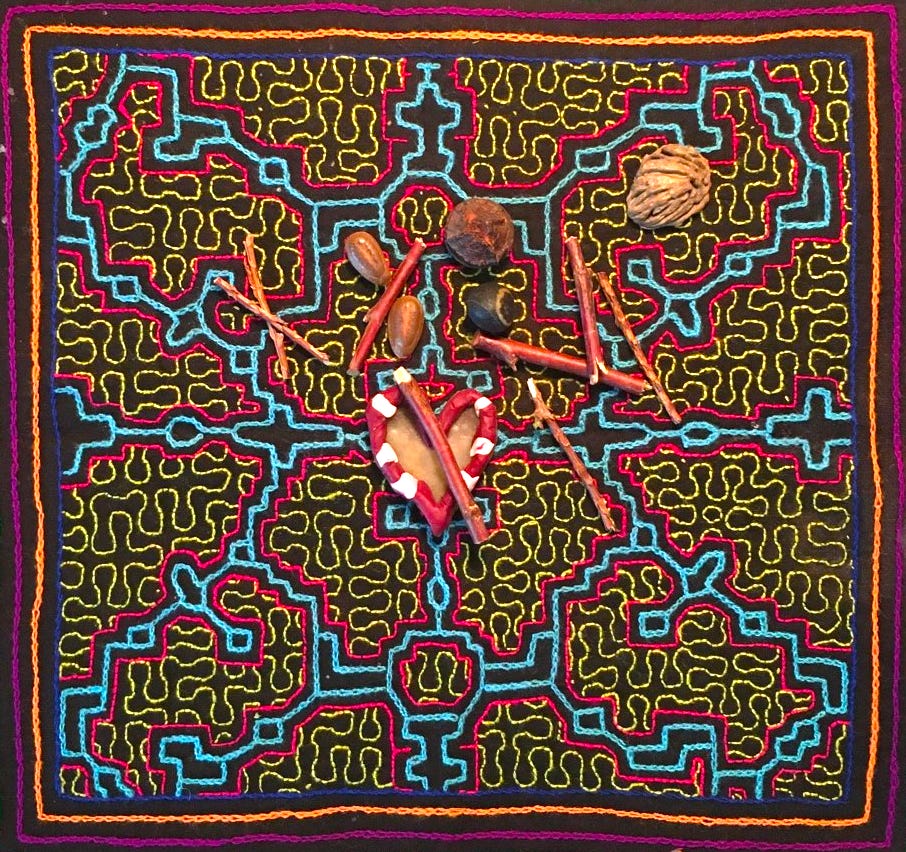
Dad follows Mister Roberts to the 2RS room. It’s darker in there. Smaller. The individual windows don’t let in as much light as that wall of French doors in the other room, and the walls here are paneled with dark wood. Tucked in the back corner, a round table with a lamp, and two small candles already burning. On the table, a smallish square black cloth embroidered with brightly colored threads. The threads create a patterned field of glowing swirls on which various items appear to be resting in a scattered way.
Pointing to the items on the cloth Mister Roberts calls them players. He says the cloth is like a stage. He describes “the basic premise of divination in every culture” as “everything is connected.”
“Everything,” he says, “time, space, action, thought — all are spirits connected through spirit. I call it the surreal continuum.” He smiles like it’s a private joke, but Dad half-smiles too. He’s interested.
“Divination? What is that exactly?”
“An oracle.”
“Like a voice of the gods?”
“An alternative way of connecting with the infinite.”
“The infinite?”
“As far as we can tell space doesn’t end. Inner space doesn’t end either. I don’t know. It’s impossible to define the infinite, almost by definition. It can’t be defined. We can’t draw a line around it with words.”
“I suppose not.”
“So shall we just have an experience? Shall we play?”
He says the communication will happen through these players.
“You’ll hold them in your hands, shake them up and then let them fall where they may. The way they fall is the communication.”
Dad nods. “Like rolling dice, I guess. Random chance.”
“When rolling dice brings up winning numbers, it sometimes doesn’t feel so random anymore.”
“Sounds like fate.”
“It does,” says Mister Roberts.
“But can fate be trusted?”
“Is the universe friendly or unfriendly? Einstein said that is the most important question a human being can ask.”
“Yeah.”
“What do you think, friend or unfriendly?”
“Life is just life. Things happen. Beautiful as the stars and galaxies may be, the universe seems cold and anonymous. Strangely silent.”
“I guess you could say, with 2RS we’re hoping that a responsive universe will provide us with a friendly fate, even if nothing can be proven.”
“Yes. It’s like a game, you said.”
“ At the same time, I understand that we’re playing for high stakes — and with heavy hearts too. I get that.”
“Yes.”
“Would you like to meet the players? They too are spirits, after all. Or they can be seen that way.”
Mister Roberts introduces Dad to each item, then gives him time to explore their spirit. He examines the players curiously. The only human-made object is a heart placed at the center of the cloth, made years ago when Lee Roberts’ son was a six year-old boy and they were playing with clay together. Dad takes the two look-alike seeds from the group of players and puts them next to each other, near the heart. Now I see him move the twigs so they’re lined up together next to the round black stone with a ring through it. He looks at the shiny inner side of the half a peach pit and places it next to the eucalyptus seed. All lined up like a cast of cartoon characters. Like the two different cups. Like the fire in the other room.
Mister Roberts begins placing glassy black pieces of stone along the border of the cloth, the “stage.”
“What are those?”
“Bits of obsidian, to keep the negative spirits at bay.”
“So evil spirits are real too?”
“I’ve got us protected. Most negative spirits aren’t evil so much as just darkish, or shall we say, less than light. It’s more like they’re in the dark. Due to their limited definitions, and the subsequent narrowness of their perspectives, they tend to exhibit a negating influence on love’s possibilities. For our situation here, that negating power could result in unnecessarily prolonging an otherwise transitory moment of confusion, bewilderment, doubt, or whatever. Doubt and bewilderment occur naturally whenever a situation changes or becomes unstable. But dark spirits tend to take advantage of this as their personal opportunity to nest and breed by turning ordinary transitional confusion into stagnation and myriad blockages. It’s like the way fear can lead us into seeing and even doing scary things, which creates even more fear. Darkness propagates like that, so that fear, instead of flowing and informing us, as emotions naturally do, becomes instead an entrenched patterned state, perpetuating additional fear, constriction, and rigidity of both mind and body.”
“In other words,” Lee continues, “in our Radical Rapport with Spirits — this 2RS game — we’re intentionally doing something that is not ordinary, something beyond the boundaries of official consensus or common sense. Which is no big deal, really. What’s common sense, anyway, but peer group pressure for adults?”
Dad shifts in his chair.
“Nevertheless, moving beyond consensus into new ways of seeing reality can be tricky, even a little dangerous. It’s like random cars driving through a parking lot with no lanes. That’s why we need helpers. If we’re going to venture beyond the margins of conventional human perception, we need all the help we can get! So, having a specific intention is necessary, and the more unorthodox our travels and our perceptual experiences, the more protection and help we need for staying on track with that intention.”
“Which is what, exactly?”
“Our intention is to generate an enhanced sense of contact with your son. What’s his name again?”
“I never said.”
Dad’s shoulders hunch up and his eyes close tight. His hands cover his face.
Mister Roberts waits, while Dad floats away. Mister Roberts is both solid and watery all at once, like people get when they’re feeling another person, and just letting things be. That’s the effect of a world-wide human family spirit so powerful it can be felt on both sides of life! It gets deeper the more you wait, and then people who are lost maybe don’t feel so lost anymore. My Dad’s coming back.
“His name was Bobby. Is Bobby.”
“Bobby.”
“Yes.”
“And the pinecone reminds you of Bobby.”
Dad hadn’t realized he was still holding it in his hand, that he’d brought it with him to the 2RS room. “It got kind of smashed in my pocket.”
“Go ahead and put it on the table if you’d like. It could almost be one of the players. It’s the right size.”
Setting it near the edge of the cloth, next to one of the two orange candles, Dad says to Mister Roberts, “What about these players? Are they dark?”
“They may feel dark to you, in the sense that you’re meeting them for the first time. You don’t know them yet, so they’re un-illuminated. They become illuminated as you make friends with them. In the surreal continuum I was speaking of, it’s all about rapport and friendship. Affection. Agreements. The agreements we make with our friends create new definitions, new spirits, new possibilities. Which of these players would you like to make friends with first?”
“I’m not sure.”
I want Dad to imagine being a kid, like I was, but he won’t go there yet.
Mister Roberts keeps going. “Is there one in particular you feel drawn to at this moment?”
“Drawn to?”
“That catches your eye.”
Dad nods, looking at the pieces, the players.
“With 2RS we proceed by way of attraction, along paths of association. Is there one particular player here that draws your attention?”
“That heart shape.”
“Ok. Yeah. I made this with my son when he was little. Go ahead and pick it up. Check it out.”
“I think of Valentines….”
“Kind of corny?”
“Yeah, it’s sentimental. But I like it anyway.”
“In this 2RS process the heart is placed at the center of the cloth. All the other players are dropped on top and scatter around it in various ways. The way they fall will make a pattern. We’ll use that specific pattern to connect with your son.”
My Dad looks at the cloth, then back at the heart in his hand. I feel him sway slightly at the swirls of the cloth as he places the heart at the center. It reminds me of the way he used to button my coat.
“What grabs your attention now?” says Mister Roberts.
“The two seeds. That’s kind of like my son and me.”
“Alright. And, just to connect with the seeds themselves, what color would you say they are?”
“Kind of a greenish-brown, shiny. What are they?”
“A few years ago I was at a Sabbath dinner in Peru. We were served what one of my hosts described as an Incan fruit so delicious that it was your last meal before getting sacrificed to the gods! It was good too. So I saved the seeds. But of course none of that’s as important as how you feel about the seeds, how you experience them right now. You said they maybe remind you of you and your son.”
“They look like little space capsules too.” Dad picks one up. “I remember flying paper airplanes with him. We’d also talk about outer space. He loved outer space! Stars, galaxies, the endlessness of all — impossible to understand. He lovesthat!”
“Go ahead and put those seed-spirits exactly where you want them for now, and let’s see what calls you next.”
He puts them down, but doesn’t really want to, I can tell. He places them side-by-side on the heart, at the center. Now he’s looking at the rest of the players.
“That stone,” he says. “Is this natural? So perfectly round, like a marble — and with this weird white ring running around it. I’ve never seen anything like it.”
“Looks like a marble, you say?”
“Yeah. Like an eyeball too! Not exactly, but it makes me think about seeing.” He picks it up and rolls it in his hand. “I like the way it feels.” He holds it up to his eye. “It almost feels like it’s looking at me!” They both laugh. It’s like an invisible tug. I laugh too. Dad puts the eyeball stone near the two seeds, just above the heart. He moves the eyeball a little so that it’s looking at the seeds. He looks at Mister Roberts. They both smile.
Dad sighs, and the air bends a little.
“What next?”
“These sticks.”
“Cedar twigs.”
“Yes.” He separates the four skinny twigs from the four thicker twigs. “I’m remembering building with Lincoln Logs when I was a kid. That wood smell.” He picks up one of the skinnier ones, holds it close to his eye. “So straight. Tiny wooden lines.” Laying the twig back on the table with the others, he says, “I think of them as lines of force, all lined up here. Pointers. Like little spears. We used to pull up these tall dry stalks and hurl them like spear-rockets through the air, my brother and me.” The air bends again as my Dad thinks about his brother who also changed, like me. Gravity bending space. Dad’s arm reaches out to pick up another player — the peach-pit half.
“It’s so shiny on the inside, and rough on the outside. Another seed.”
“I think of this as one of the two-sided players.”
“A spirit with two sides?” says Dad. “Rough versus smooth.”
“Yeah. Or coarse versus shiny….”
“Dark and light, tough and gentle. Wouldn’t that be like two different spirits then?”
“Sure,” says Mister Roberts. “Two-in-one.”
Dad sets the peach pit next to the two other seeds, shiny side up. Looking at the cloth, the heart, and the other players, he says nothing. Images of Dad slide by, pulling a sled with me on it. I remember Dad carrying me on his shoulders too and how I’d laugh. Up that high, it was like outer space!
“One left,” says Mister Roberts.
“Fascinating.”
“Yes?”
“Its structure. The opening at the center is like a star. The other side divided into four distinct quadrants. What the hell is this?”
“It’s a eucalyptus seed, from a tree in California.”
“It’s complicated. Another one with two sides. That one side has this opening, this star. The pattern on the back is like a pie sliced into four pieces. Something organizational about it. But the side with the star, the opening, feels somehow receptive. There’s space in it. Space inside. I see my son and me looking up at the stars again. We’re camping in the Catskills. So dark up there, so brilliantly amazing. My God, those stars! Bobby would go completely silent. Both of us. Standing there with him it’s like I was seeing it all for the first time.”
The air around the lamp folds and bends as time itself collapses softly around Dad’s heart. How well I know this heart! My bird’s nest.
“Dan?” Mister Roberts calls him back.
Dad turns. “It’s as if nothing really ends.”
Lee Roberts smiles. He thinks of his own son somewhere out in the world, and not knowing where. Suddenly something moves Mister Roberts’ mind and he’s thinking, “My son is no more lost than me!” But all Dad would have seen, if he’d been looking, is Mister Roberts’ jaw line, and his lips pressed together.
Dad’s peaceful, looking at the four-part face of the eucalyptus seed, where Mister Roberts is now looking too. Then he places it between the two piles of twigs, star-side facing up. There’s an opening in the space between the two men. Everybody’s a relative in the same family! I can hear my all-time favorite song all around me, by the fairy queen of Iceland! “You’ll be given love. You’ll be taken care of…. All is full of love….” I want to bring my Dad a joy like this!
“I feel strangely affectionate toward these weird little objects,” Dad says.
“They’re sort of alive,” says Mister Roberts. “Eh?”
“Yeah. Spirits. Players. A whole cast of characters on this weird little swirling stage.”
Lee smiles. “I like to call it a theater of presence.”
“Yeah,” Dad laughs, “animated by your psycho-philosophy of as if…. Feels like we’re about to enter another world!”
“We might be part-way there already….” says Mister Roberts. Pinching his nose in a strange way, he adds, “It’s not really so far away, though. You’ve heard we only use about 10% of the brain? With 2RS we’re now expanding brain usage to maybe 11%.”
He laughs at his own joke, if it is a joke, and Dad nods, liking the idea, but wondering, Why 11?
“Let’s ring the bowl,” says Lee, “and make the switch!” From underneath the table he brings out something made of brass about the size of half a human skull. “Would you like to try it?”
“What is it?”
“A singing bowl from Tibet. Just tap it with this stick.”
My Dad seems awkward, but when he taps it there’s this clear ring. I feel circles expanding through space, and then through time. I see Dad’s curious look again. He’s enjoying this.
“Feel how it kind of clears the air?” says Mister Roberts. “Let’s hear it again.”
All three of us listening together, it’s as if the air itself bends into the bowl. There’s a calming “spirit” in the sound, as Lee Roberts might say.
“It sort of wakes me,” says Dad.
“Yes.” Mister Roberts reaches over to some dried leaves cupped in an upside-down turtle shell. “I also like to burn sage as part of the process, he says. “I know all this must seem awfully ritualistic, but it actually has a very practical side. To get that extra 1% of new brain we need to expand the sum of our senses. We just woke up our ears and our listening, with the singing bowl, and now we use smell, the aroma of sage smoke. You don’t mind the smell of sage, do you?”
“Never smelled it.”
Lee lights a few of the dried silvery leaves, letting them smolder in a ragged little plate made of charred tin foil. Dad’s nostrils widen. The smoke rises in curling streams through the mind’s memory tree. Images of him hugging me. I see how smart they are, those smoky octopus arms, drifting and moving, like the magic part of the brain.
“The shapes of the smoke are never the same twice,” says Lee. “It always refreshes my eyes to watch the way it moves, the forms it takes.”
“I suppose by watching patterns of smoke we’re also waking up the eyes?”
“That’s right!”
“I do like the smell. Like the desert after it rains.”
“Ah….”
Both of them are breathing a little more slowly than before, as the tendrils of smoke spread evenly throughout the space, seeming to disappear.
“And now,” says Mister Roberts, “in this slightly meditative state, the only thing left to do before we formally begin is to grok the inexpressible!”
Dad laughs, “Who the what?”
“I figure the bottom line of all this, of life itself, is that it’s totally inexpressible. Being alive is beyond words, you know what I mean? Beyond comprehension. It’s like looking at all that space in the sky with your son as if seeing it again for the very first time. What is it? How far does it go? How can all this even exist? And how did it even begin! I mean there is no end, you’re right — it’s a total freefall, really. And that can feel scary, almost awful. But then there’s awe. The dis-ease of dread becomes a medicine of wonder. And so I grok the inexpressible to remind myself that it’s all beyond words, more than the mind can ever grasp. I mean, it really is.”
“Grok?”
“Grok: to feel into and sense with my body what I can’t understand with my mind. It’s an interior physical sensation. And the reason we do this as preparation for 2RS is because communication with the dead is also beyond comprehension. It’s absurd! I might imagine I understand what’s happening here. I can talk about it. But the words never feel quite right. Words are a shortcut, maybe, some kind of indirect pointing to — but not the experience itself. When I grok the inexpressible it’s like I’m softening myself into a strange non-conceptual arena, becoming intentionally fuzzy, in a way…. And yet there’s this feeling of radical receptivity — a stillness inside me that beholds.”
“I think I get it. Beholding. Almost like the mind holding its breath.”
“Yes, that quality of just waiting. Except we keep breathing.”
“Breathing while waiting.”
“And waiting while breathing!”
They laugh.
“Behold!” says Mister Roberts. And he taps the bowl again.
Closing their eyes, they listen.
As the ringing fades, the way the smoke faded too, Dad opens his eyes. He’s seeing the 2RS stage and its players with a strange, almost beautiful, vividness. The air’s bending again. Looks like he might be near a waterfall.
Mister Roberts opens his eyes too and lets out a sigh. “Okay. We’re getting there.”
“I want to talk with my son. I do. But I don’t see how this is possible.”
“Let’s say that it’s not possible, Dan. You’re right.”
My Dad covers his face, then drops his hands just as quickly, looking Mister Roberts in the eye.
“And yet, impossible or not,” says Mister Roberts, “something is about to happen here.”
“My son died. I miss him. He’s gone. I’ve been walking around dead for months, like a man wanting to fall asleep in the snow…. I’m…I’m really…,” — his voice drops to a whisper — “I’m so angry. I hate myself this way. All of this. I hate it! I hate god. I don’t even believe in a god! But it’s like I have to hate someone!”
Lee’s voice is quiet: “God can take it.”
“Jesus, what is going on here! I don’t understand…born just to die, loving people just to lose them forever. Flat out gone! It’s like there’s this hole in my head…I can’t even think! I want to go to sleep. I don’t understand!”
“Neither do I, Dan. In fact, 2RS is based on my total lack of comprehension! And also my longing to not live in dread….”
“What if you’re fooling yourself?”
“Yeah….”
“Right after my son died I kept thinking I saw him. That still happens sometimes. It’s just… Losing your own child…it’s just unimaginable. I don’t see how I go on like this.” Up comes a choking sob…my hand rests on his heart…. He stops himself. His eyes dart around wildly.
Connecting with my Dad’s eyes, Mister Roberts says, “I wanted a new possibility, and then I imagined it. Or should I say, it came to me. You see, how we phrase it determines what it is. The actual experience was that 2RS came to me. What is that? Where did it come from? I wasn’t trying to think it up. It came to me. Just think about the madness of that. Things come to us all the time. Ideas, images, feelings — they come flowing through, they arrive like guests in our house, and we hardly notice how that happens — or that it’s even happening at all.”
My Dad’s shaking his head, the way he used to when I’d tell him one of my dreams.
Mister Roberts keeps talking, “I can’t begin to understand precisely how 2RS came to be, or even how it is we’re both sitting here right now. All I know is that 2RS works. Something always happens.”
“Let’s just do it then.”
A little bit sadly, Mister Roberts smiles. Dad can see it in his face, a sparkle in one eye, a tear in the other, and Lee Roberts says, “Are you feeling the inexpressible?”
“Yes! Are you kidding me? There’s no way to say what I’m feeling about my son right now, and it’s killing me.”
“That’s exactly what 2RS is for, my friend.”
“To keep me from dying?”
“Well…or to help us die into a different way of seeing things. Didn’t Socrates say something like the real purpose of philosophy is to teach us the art of dying? But what I’m talking about here, what underlies this game of radical rapport, is a philosophy of no words. As you’re finding out, when we grok the inexpressible, we start to feel. We start knowing, without explanation. And sadness comes, yes — but it isn’t just because of death. Reason gets moody when it’s forced to admit it can’t understand. Reason grieves its own limitations. The big computer gets scared! But like the poet said, Love has more courage than reason! And love’s brain is much bigger too.” Mister Roberts tilts his silvered bird-head sideways.
“There’s a sense of impossibility in all this,” Dad says. “Hopeless.”
“Reason throws a fit, like blind Samson in a temple. We live. We die. One way or another, we will eventually lose every single person we ever loved! This radical severing from your own son by death has made the inexpressible come alive for you, and it’s unrelenting. It’s fucking intolerable! And it’s completely normal for it to feel intolerable. And it’s also completely intolerable for this horrifying thing to be normal, you see? And yet we do tolerate it. Or else we die of it. Loss can actually kill us. We know this. That’s why I like the idea of the inexpressible — it helps me tolerate the intolerable just enough to start getting curious, and maybe even follow where all these fucking feelings lead. What if your son’s absence is not a brick wall but the clue to a mystery? What if we stopped thinking we understand what death even is?”
My Dad is shaking his head, more like a rhythm than a “No.” I’m holding him somehow. Feeling is liquid.
“I can’t directly feel the exact nature of your loss, Dan. Close, maybe. But I can feel the inexpressibility of it, and we can be here in that.”
“In a shared loneliness.”
“All around us, yeah, that’s part of it.”
They’re both looking down at the small round table, the two orange candles burning, the square cloth of embroidered swirls, and those odds and ends laying there that Mister Roberts calls “players.”
Facet Three
“Sometimes I want to die too,” I told Dan. “But when I sense the inexpressibility all around us, and simply wait, I start feeling something even larger than my own catastrophes. Larger than my greatest longings. More vast, somehow, than everyone I miss. Larger than happiness too. Or maybe it’s nothing, but there’s this level of reality where everything seems inexpressible, where nothing can be spoken, only felt, and somehow known. I wonder if this silent feeling doesn’t run through us all?”
Though he seemed in a bit of a trance, I handed Dan the leather book. He was slow to take it, but then sensing the texture of the cover with his hands, Dan’s head lifted.
“What’s this?”
“A Shrine for the Nameless,” I said. “All kinds of quotes related to the inexpressible, I put them here — poetic verbal pointers, just to help me shut up! It’s a warm-up procedure, part of the 2RS protocol. Open the book anywhere at random and whatever your eye falls upon is the quote we’ll use to send us on our way. It’s time for 2RS.”
With half a smile, Dan shook his head, opened the book, paused a moment, and read the words of Hakuin:
“Both inner life and the floating world around us
“Are like the blind men’s round log bridge —
“A mind that can cross over is the best guide.”
He grunted.
“Zen poem. Let’s not talk about it,” I said, a little too quickly, “We’ll just feel it. If it paralyzes your mind, all the better!”
“The quote on the opposite page also caught my eye.”
“Your other eye, huh?”
“Guess so. Maybe this will help explain the first?”
“Let’s hear it.”
“We entered swiftly and easily into silence as we built with sticks, stones, and leaves around a white candle. I remembered ‘The Attunement of the Rocks’ as spirit moved toward harmonic and cryptic placements.”
He looked up at me, we looked at each other, and since nothing explained anything, we burst out laughing. I sensed an incongruous, almost festive vibe in the air between us. For a moment, colors seemed richer. The curtains, velvety red. The black cloth on the table, the spiraling threads radiating a mild electric blue, and the delicious wooden browns of the cedar twigs, the eucalyptus seed. Even Dan’s eyes seemed bluer — Adriatic — like my Slavic grandmother’s eyes years ago. A bird appeared outside the window, looking in. Then it was gone.
I picked up the players and gave them to Dan one by one. The cedar twigs and the eucalyptus button, the two Incan seeds, the peach seed half, and the eyeball stone. I had no idea what Dan was feeling, but he seemed receptive.
“So take these players in your hands, and shake them up. Like tossing dice, like you said. As you shake them in your cupped hands, meditate on your son, like you did before you found the pinecone. See if you can hold the meditation not in your head but in your chest. In the heart area. Can you feel a warmth there?” Dan’s eyes were closed. He seemed surprisingly relaxed and just nodded.
“Settle into your own breathing, then,” I continued. “Breathing’s beautiful, isn’t it? Whenever it feels like the right moment, hold the pieces above the heart at the center of the cloth, and let them drop. This way, the way they fall, we’ll consider that to be a response from your son, something he wants to say or show you.”
Dan followed my instructions. When his hands opened, the pieces scattered across the heart and the cloth. Dan grimly surveyed the array of players as if it were a chess game. A game he had no hope of winning.
“Gobbledygook, eh?”
Silence.
“It’s always a bit overwhelming at first.”
“Will you be quiet?” he said.
I chewed my lip.
“I don’t know what to make of this. How’s it supposed to work, again?”
“We’re working on the ancient premise behind every form of divination on Earth throughout all time: the assumption that everything happening in a given moment is connected. That life is a weird oneness. That the exact way these players landed on the cloth can’t not be somehow connected with the thought or question you were holding in your heart at the moment you dropped them.”
“You mean meaningfully connected, like there’s a meaning here.”
“Something purposeful trying to come through.”
“I’m not sure I really believe that.”
“Understood.” I bit my lip again. Hadn’t we already covered this ground? I reminded myself, he’s the Seeker, I’m the Grief Mediator, the go-between for whatever message or feeling is trying to come through. I needed to count on the fact that he’s seeking, that something in him is genuinely trying to open up, despite all obstacles, thought-habits, horrific pain. I didn’t necessarily want him to know I’d never done this before with anybody besides myself….
“Actually,” I reminded him, “You don’t need to believe it.”
“Oh, yeah. Right. ” He scratched his chin. “Weird.”
“Let’s see what happens when we act as if everything on this cloth is connected somehow in a meaningful way.”
“You mean, pretend.”
“Yes.”
“This whole thing is based on pretending?”
“At this particular point in the process, yes. It appears that way.”
The Seeker shook his head. But his eyes stayed on the pieces.
“Let’s play with these players,” I said. “Let’s be curious. Let’s see what happens if we entertain the possibility that there’s something meaningful going on here, and that it’s directly related to your son — that he’s reaching out to you through the way these things fell from your hands and gravity scattered them around.”
“Well, why doesn’t he just send me an email!?”
“I wouldn’t rule that out, but my research indicates that relations between the living and the dead move along in ways that, more often than not, are indirect. Nonlinear. Irrational. What have you. Obscure! Poetic! Dreamlike! I don’t know. Not like an email! Let’s just say the dead don’t have Wi-Fi, but maybe they will eventually. I have no idea!”
“Oh God, what bullshit.”
“Oh Bullshit, what a GOD!” I immediately wished I’d kept my venting to myself. Let him Seek. Let me Mediate. Build the bridge. Be gentle! Be patient!
He cracked a smile. “Bullshit is a kind of god,” he said. “God of disaster and bullshit. You flipped my head around so many times today I don’t even know where I am.”
I waited. I could see things were working in him. He touched the cloth. He fiddled with his face. He closed his eyes. Opened them. I had decided to shut up, and he seemed to be deciding whether or not to go for it. There was some kind of resolve in the air, a mood that materializes things.
“So you mean, if my son could communicate with me, then the way these pieces fell is his message.”
“Yes.”
“I’m sorry, Lee, but my grandfather’s all-time favorite word now comes spectacularly to mind — malarkey….”
I laughed. “Of course.”
Our eyes connected, our faces — our inter-face — relaxed. And then as if a fluid began floating through my brain, something funny happened.
“Alarm key!” I said.
“What?”
“Malarkey in my head just switched and spelled alarm key!”
That seemed to push Dan over the edge. “Alright alright alright. I’ll turn off the alarm key! I’ll play with you here, and let’s just see what happens!”
I didn’t care that his voice was raised, the Seeker had acquiesced to his journey. Perhaps the Grief Mediator could settle down now. I prayed to God to help me shut up.
“But, here’s the deal,” said Dan. “If what I’m looking at here is a message from Bobby, there’s no way I can understand it, this random chaos of shit you just picked up in the woods somewhere….”
“It looks like a mess, sure,” I laughed, “but just think how far this message has come! I don’t mean literal distance, miles or light-years, I mean dimensional distance.”
“Well, I’m stumped.”
“Or, let’s say that what we’re seeing here is a communication that hasn’t quite arrived yet. The transmission is still occurring, but we’re not quite at full reception.”
“Like radio static when the dial’s not quite on the station.”
“And you’re the receiver.”
Dan nodded, bent his head, looking more closely now at the arrangement on the cloth, the players on the stage.
“One way is to start with the Heart,” I said. “See where the players are in relation to that heart.”
“Is that supposed to be my heart?”
“It can be.”
His hand on his chin, that chess-player look again, the Seeker said, “The pieces are mostly above the heart — my heart, let’s say. Almost as if they’re falling down upon it from above. And there’s that one twig directly across the heart itself. It’s like they’re dancing. Frozen in a dance. Like a snapshot of people dancing. That stick right on top is crossing the heart like a sash, like a soldier wearing a sash.” Dan laughed, eyes still fixed on the cloth. “Actually, I can imagine Bobby telling me I’ve been acting too much like a soldier since he died. That sash could even be a round of bullets, some kind of Rambo character!”
Dan continued to muse quietly.
I made some notes. “So, it’s kind of like he’s saying, ‘Dad, you’re acting like such a soldier!’”
“Yeah. I was hard on him when he was little. Pretty strict. I come from a military family. You know, Stand up straight! Be disciplined. Stop whining! As Bobby got older, and I got older, it became more of a joke between us. If I was too clipped with him, he’d salute and look serious, but always cracked a smile. And I’d just have to laugh at myself, and ease up. He was a good kid. I didn’t really need to push him.”
I nodded, as he sighed and looked at me.
“He really was a good kid.”
I thought of my own son too, and our distance from each other. But I was feeling close to Dan.
“He’s telling me I’m being too hard on myself,” Dan said, “playing soldier, as if his death is just one more casualty in some kind of war, and the show must go on!” The candles glowing near the cloth seemed to draw his eyes back to the players. “And now I’m seeing this.” His finger indicated how the “sash” pointed, or led, toward another cedar twig. “See the two seeds, with that stick going right between them? That’s definitely Bobby and me, and the boundary between us.”
“Boundary?”
“Between life and death, between here and the other side. Or whatever.”
“So what might he be saying about that?”
“There’s something between us.” He nodded his head, pushed out his lips for a moment. “I mean even before he died, something had come between us…. But look — see how one seed seems to be following the other? Down toward the heart? And yet the upper seed is blocked by the twig between them. I see us moving together, and yet separated. That’s like right now. I mean, if he and I really are communicating, that’s the connection. Despite our separation.”
Dan shifted in his chair, becoming even more energized.
“And look! Look how the divider or boundary twig points up toward that button, the eucalyptus seed. It’s face down, so we can’t see the star but the back side of the seed is interesting too — that quadrant, like a compass.”
“I see that.”
“I think it’s something about getting your bearings, getting oriented. Like maybe he’s encouraging me to get my bearings through this communication process we’re doing? Man, I’m not sure.”
“Let’s go with that,” I said to him. “Get your bearings.”
“I’ve been so mixed up. Almost dizzy half the time. Just floating.”
“Suspended animation.”
“Yeah, when he died, everything just stopped…. Look, that peach pit landed with its rough side facing up.”
“I guess that makes sense.”
“Things have been rough!”
“For sure.”
“Bobby’s telling me he knows it’s been rough!” Dan’s shoulders started to shake but he wrangled himself under control.
“So it’s like he’s saying, ‘It’s been rough for you, Dad.”
“Yeah. Like he actually knows that. I’d sometimes get the feeling with him that he knew me from the inside.”
“Maybe that’s why he was so good at getting you to laugh at yourself….”
“Exactly.” Dan’s hand smoothed his other hand.
“So what would it mean to get oriented, get your bearings?”
“For starters, just acknowledge where I am, what I’m feeling. Be honest with myself. Recognize the deadness I’ve been carrying around. That’s the soldier. Fortitude! Guts!”
“Numbness.”
Dan nodded. “Everything changes when I simply admit it’s been rough. Really difficult. And then just letting in the possibility that Bobby knows it’s been rough, that helps. It helps to just say, Okay, this is the way it is right now — it’s rough!”
There was a slight tremor in his voice. I imagined clods of earth starting to fall, as if there were a cliff inside his head. Again, he pulled himself together.
“I don’t know about the rest of these twigs, or that strange round stone. What did you call it?”
“The eyeball stone.”
“Right. The way it’s just below the eucalyptus seed like that, maybe the eyeball stone’s related to getting oriented? The underpinning for getting my bearings.”
We locked our eyes on the stone. In my peripheral vision I was aware of the candles again, of a shadow waving to me in the light. I said, “Sometimes I just turn my own eyes to see where the eyeball stone is looking.”
“The window. It’s looking outside through the window.”
“What do you see?”
“Mainly that tree, the big pine tree.”
I was silent, looking with Dan at my beloved conifer. It’s one of those living beings that calls for attention. Once you notice it, you can’t stop looking. Very old. Healthy too. And probably more anchored here on earth than I’ll ever be. I’d go so far so as to claim that we were receiving something from that tree during those moments of looking together. Something was coming in. We weren’t just looking, we were feeling the pine tree. The stillness grew so palpable, perhaps the tree was feeling us as well. It was a kind of spell, until Dan glanced at me to see if I was still there, and suddenly it came to me. “Hey, I know, try facing the 2RS cloth, but this time, close your eyes, and without moving your head, move your eyes inside yourself, in the direction the eyeball stone is looking.”
Without a question, he held still, and did just that.
“Keep breathing,” I said, sensing he was tensing up.
“I feel like I’m going to see him!”
Dan’s hands gripped his thighs, with a big intake of breath.
Then he shifted his position and opened his eyes, but not to look at me. “You know, I lost Bobby once, when he was three years old. We were at the City Aquarium. It was a crowded day, and we’d had a wonderful time there among the fish and other wildlife. We were wandering through the final room of aquatic tanks where the crowd was the thickest of all, and suddenly I realized Bobby wasn’t there. I turned around, but he wasn’t behind me either. It was inconceivable to me that he could have gotten very far, but he was nowhere. I mean nowhere. The only way I could make sense of him vanishing so quickly was thinking some molester must have grabbed him, and I hurried to the restroom, looking in every stall. I was frantic now, and when he wasn’t in the men’s room I realized I’d just wasted precious time looking there. I ran back out to where I’d last seen him, people were milling around everywhere, and each moment I didn’t find him meant another moment he was slipping farther away. My mind went racing — I thought I was gonna lose my fucking mind and knew I couldn’t lose my mind because then I’d never find him, yet the more time went by without finding him the more I could feel myself completely losing it. I started talking out loud…My little boy, my little boy…I can’t find my little boy!…I was beyond caring if I looked like a crazy man or not, and my voice got louder. My boy my little boy I LOST MY SON! But that’s what it took. As I got louder and more out of my mind, then people started coming toward me, trying to help, asking questions — but I could only see them vaguely, I couldn’t hear anything at all except my own voice, “I LOST MY LITTLE BOY!”
And then Dan couldn’t hold it together anymore. Didn’t even try. We both cracked. He was leaning forward, I turned my chair so I was directly facing him, put my arms around his back as his shoulders heaved.
And then he sat up.
“But then, you know what, there he was! The crowd all around, it was like he just came out of thin air! He looked spaced out. He hadn’t even realized he was lost, I don’t think. And that was it. It was over. The nightmare was over!”
He leaned forward again, sobbing. All my grief woke up too. My son isn’t dead, but he’s gone. So far away. Something happened with him, I’m not even sure. But Dan lost his son all the way, forever! Suddenly I saw us scared human beings, how we hold back, we don’t love as much as we could!
Something tapped on the glass, that same bird had come to the window again, and as we both looked up the bird flew off. But out the window, right in front of the pine tree, we now saw a deer with antlers going by.
When the deer was gone, after the bird had already come and gone, there was just the pine tree standing there. And then Dan noticed the tiny dented pinecone he’d brought with him. “Something weird just went through my head,” he said, talking fast, “The smashed pinecone is equal to the pinecone of perfection. Huh. Oh! I just remembered, Bobby used to call them wooden flowers! You know, he once found this little pinecone and put it in his pocket. But when he got home it was messed up, part of it had gotten crushed, and he was so upset. Of course I thought it was silly, but his heart was truly broken. I wish I’d known how to respond better…. And now this pinecone, the reminder of Bobby you had me bring here today, also got smashed, but what just came to me, it’s so weird, it doesn’t sound like me talking, it sounds like Bobby, the way he’d joke around trying to sound like the Karate Kid’s teacher — but this isn’t a joke. He’s serious. And yet he’s playful too, even joyful, “The smashed pinecone is equal to the pinecone of perfection!” Is he trying to help me?
“Does it help?” I whispered.
“Not really. I’m not even sure what it means.” Dan paused. “And yet the feeling that Bobby’s trying to help me, that helps. It really does. I feel him here. The smashed pinecone is equal to the pinecone of perfection….”
Our eyes met, and rested.
Facet Four
The shared presence between these two men is palpable.
“Does this feel like enough for now?” says Lee to Dan Hunt.
“Yes.”
Lee Roberts nods, balances the singing bowl on his open palm and, with his left hand, offers the stick to Dan. “Ring the bell? Tap the bowl?”
“That’s weird,” says Dan, “I was thinking you said owl. Tap the owl.”
“Another ancient Japanese poem!”
The bell doesn’t ring,
nor does the stick —
The “between”
rings
Having grown accustomed to unexpected things coming out of Lee’s mouth, Dan smiles.
“Maybe that owl flew in through the in-between!” says Lee. He extends the bowl a little closer toward Dan. When Dan taps it with the stick, their listening together invisibly expands in space. As the ringing grows wide, it also grows more faint and fades away. The men are like vapor, and the room itself becomes relaxed. The 2RS room.
Lee’s voice, quietly now: “As we begin to shift out of this special time, we’ll need to dismantle the 2RS communication. But that doesn’t mean the messages are lost. After removing the players from the cloth you will then have a chance to send a message back to Bobby, by arranging those same players any way you’d like, with the heart, as usual, at the center.”
“I like that,” says Dan. But before dismantling the communication, he takes one last look. “I wonder what these other twigs are pointing to? They feel like something touching me, silent nudges. A warmth reaching across. Or like something in a handshake that we sense but never mention. I don’t have to understand every single part of what has happened here. I know there’s something unspoken between Bobby and me, without question. It feels good.”
Dan proceeds to arrange the pieces in a new way, while Lee Roberts simply beholds what’s happening. Lee’s enjoying having less and less to say, and Dan Hunt seems to know exactly what he’s doing now.
After completing the new arrangement of players on the embroidered cloth, this gesture to another world, the Seeker seems satisfied.
“Is there anything you’d like to say about it,” asks the Grief Mediator.
“Not really. You see I put the two seeds inside the heart?”
“Yes.”
“This is good, Lee. Thank you.”
“You’ve done a great job here. It’s beautiful, Dan. Beauty has its own purpose, doesn’t it? Which fulfills itself instantly. I’ll leave your message for Bobby in place for a complete cycle of twenty-four hours, and when it’s dismantled, I want you to know I’ll be sending love to you and your son. Besides wishing both of you well, this helps me to personally bring closure and wholeness to what we did here today, which has touched me in ways I can’t even begin to talk about.
“Inexpressible?”
Lee Roberts had to laugh.
Facet Five
As we left the room where the 2RS oracle had taken place, and passed through the first room where the fire had blazed and now slumbered warmly, I said to Lee, “There really is no closure when someone dies, is there?”
“Not really,” he said. “In my experience, your life just changes around the wound of it.”
“Maybe the wound of it can become a kind of opening,” I said, “something we learn to breathe through in a new way.”
He stopped and just looked at me.
I had one more thing to say. “You know, Lee, I think I really just wanted to know that Bobby is okay.” I put my hand on my chest, that treasure place, experiencing the kind of certainty that can only be felt there, though it may never be proven. “This knowing — that’s what you gave me.”
Lee took a breath, as if trying to master his own emotion. It suddenly occurred to me that in some strange way Lee Roberts might be one of the saddest people I had ever met, this inventor of 2RS. I thanked him with my whole heart, my soul really, and gripped his hand. Though we had been sobbing in each other’s arms just moments before, we were a little too shy now to give, or receive, the full embrace.
On the way home I suddenly remembered Bobby’s all-time favorite song, “All Is Full of Love.” Several times that day I listened and wept, but it wasn’t sadness really. What was it?
Later I sent that song to Lee Roberts, so he could feel it too.